
The IRS regulations at 26 CFR § 1.501(r)-3 require a nonprofit hospital facility to “identify and prioritize significant health needs” in its community as part of its Community Health Needs Assessment. The regulations are deliberately silent on how to do that. The methodology choice is left to the facility, and the consequences of choosing badly are not abstract: methodology is the first thing scrutinized in an audit, the first thing a board pushes back on when priorities feel wrong, and the first thing competitors and journalists will probe if the resulting CHNA produces surprising findings.
Methodology choice also determines what a CHNA is structurally able to see. A methodology that treats environmental exposure as a footnote will produce a CHNA where environmental exposure is a footnote. A methodology that surfaces air quality, water contamination, toxic releases, and climate hazards alongside chronic disease and provider access will produce a CHNA that can connect those dimensions. Most published CHNAs in the United States today are written using methodologies of the first type. This is the part of CHNA methodology choice that gets the least attention and arguably matters the most.
The three dominant methodology families in current CHNA practice (weighted scoring, convergence detection, and social vulnerability indexing) each do certain things well and miss others. A practitioner should be able to articulate to a board, a regulator, or a community partner why their methodology is appropriate to their community context. That defense is the whole point of the methodology section.
We have opinions about which methodologies are better in which contexts and we will say so. We have also written this guide in a way that is honest about where our own platform's methodology is the right choice and where it is not.
What “methodology” actually means in CHNA work
Methodology in a CHNA context refers to two related but distinct things.
The first is the analytical methodology: how the assessment combines indicators into a picture of community health, how it prioritizes needs, and how it identifies significant health needs from the universe of possible needs. This is the part that most discussions of methodology focus on. It is also the part with the most established frameworks to choose from.
The second is the community input methodology: how the assessment solicits, documents, and incorporates input from members of the community served. The regulations require input from public health departments, from medically underserved populations, and from at least one written comment on the prior CHNA. The methodology question here is operational: focus groups, structured interviews, surveys, key informant conversations, or some combination. We address community input methodology briefly at the end of this article, but the bulk of the discussion is on analytical methodology.
A defensible CHNA documents both. A common failure mode is documenting one rigorously and the other casually, which leaves an audit-exposed flank.
The three dominant analytical methodology families
CHNA analytical methodology in practice draws from three established frameworks. Most published CHNAs use one of these or a hybrid. At a high level, they differ along a few practical axes that matter for CHNA work:
| Weighted scoring (CHR&R) | Convergence detection | Social vulnerability indexing (SVI) | |
|---|---|---|---|
| Primary output | Single composite score per geography | Multi-dimensional pattern, threshold-based flag | Single composite vulnerability score per geography |
| Interpretability | Easy to explain; loses dimensional detail | Preserves which dimensions drive the signal | Easy to explain; covers one dimension only |
| Peer comparison | Strong; produces a clean ranking | Pattern-based, requires narrative translation | Strong; produces a clean ranking |
| Environmental coverage | Limited; environmental measures are a subset of broader factors | Depends on the scoring framework, can be primary | None directly; designed for social vulnerability |
| Interaction effects | Averaged into the composite, often invisible | Surfaced explicitly when dimensions converge | Not captured |
| Audit defensibility | Strong; weights are published and reproducible | Strong if dimensions are documented; requires narrative | Strong; CDC-maintained with public methodology |
| Best when | Cross-geography comparison drives the analysis | Multiple risk dimensions need to be visible separately | Social vulnerability is the central analytical question |
| Weakest when | Compound risk patterns matter more than ranking | A single numeric ranking is required for communication | Environmental, disease, or provider dimensions matter |
The detailed discussion of each follows.
Weighted scoring indices
A weighted scoring index combines a set of standardized indicators into a single composite score using pre-determined weights. The most influential example in the CHNA space is County Health Rankings & Roadmaps (CHR&R), produced by the University of Wisconsin Population Health Institute. CHR&R standardizes county-level measures to z-scores, applies nominal weights based on its 2025 Model of Health, and produces composite summaries for Population Health and Well-being and for Community Conditions. Counties are then grouped into ten Health Groups using cluster analysis on the composite scores.
The strengths of weighted scoring are real. The approach is transparent: the weights are published, the calculations are reproducible, and anyone can argue with the choice of weights. It produces a single number per geography, which is operationally convenient when CHNAs need to compare counties or census tracts against state or national peers. CHR&R in particular has been validated in the academic literature and is widely accepted by hospital boards and IRS reviewers.
The weaknesses are also real. Weighted scoring assumes a model of health in which the relative importance of factors is knowable and can be expressed as a fixed weight. In practice, that assumption is contestable. Researchers have referred to the goal of optimal weighting as a “fantasy equation,” because the true relative contributions of health determinants to outcomes vary by population, by geography, and by time, in ways that no single weight set can capture. A weighted score that says Smith County is in the worst Health Group nationally cannot tell you whether the problem is provider supply, disease burden, housing, or social isolation. The composite collapses dimensions that may need separate attention.
Convergence detection (compound signals)
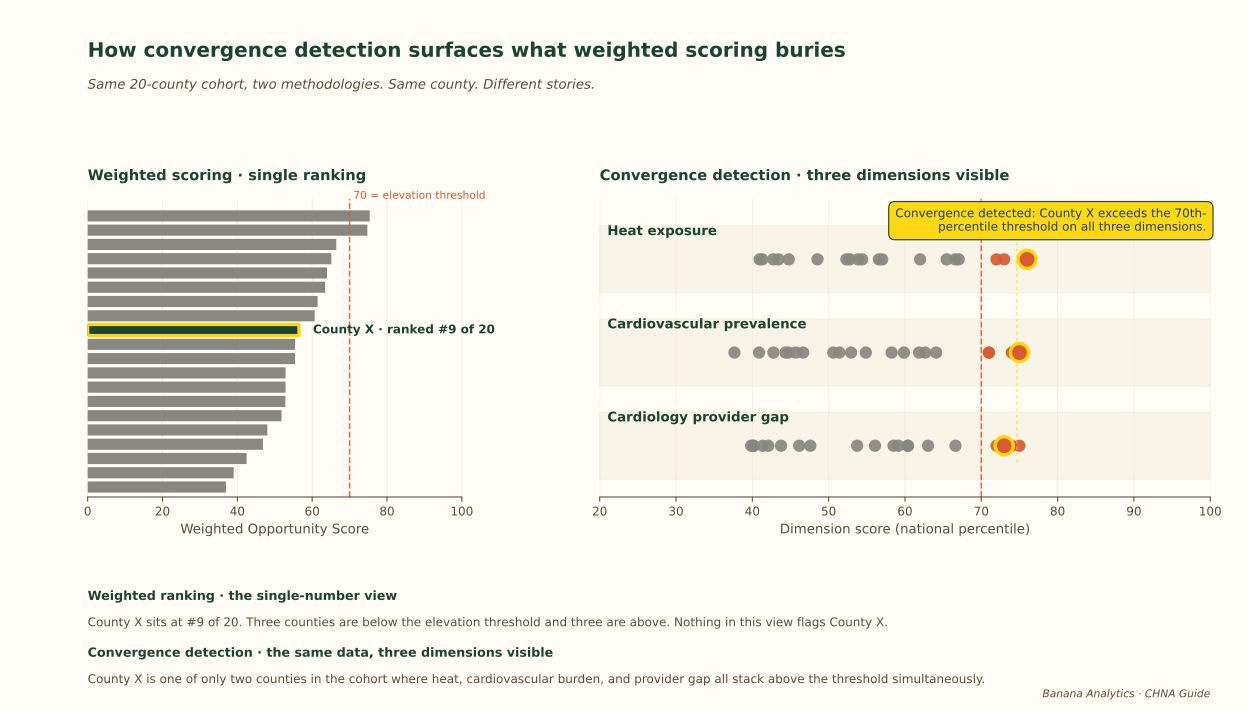
Convergence detection takes the opposite analytical approach. Instead of combining multiple dimensions into one composite score, it asks which counties or tracts have multiple dimensions simultaneously elevated, and surfaces those convergences as discrete patterns. The dimensions remain visible. The geography stays interpretable in terms of which specific risk factors stack together.
Compound signal scoring (which is the methodology underlying the Banana Analytics platform) is the most developed example. The platform scores all 3,222 US counties on four dimensions (Environmental Risk, Disease Burden, Provider Gap, Social and Economic Stress) by percentile-ranking national distributions on each dimension, then flagging counties where two or more dimensions sit at or above the 70th percentile. The output is a structured pattern: which dimensions converge in which geographies, and what the resulting compound risk profile looks like.
The strength of convergence detection is interpretability. A county flagged for Provider Gap plus Social and Economic Stress is a fundamentally different problem from a county flagged for Environmental Risk plus Disease Burden. The methodology preserves that distinction in a way weighted scoring does not. Convergence detection also surfaces interaction effects: situations where two factors together produce risk that neither would individually flag. The classic example is heat exposure plus cardiovascular disease prevalence plus cardiology provider deserts. No single one of those dimensions is uniquely alarming at the median county; the convergence of all three is.
Social vulnerability indexing
The CDC/ATSDR Social Vulnerability Index (SVI) is the most influential social vulnerability indexing methodology in CHNA work. SVI uses 16 census variables from the 5-year ACS, grouped into four themes (Socioeconomic Status, Household Characteristics, Racial & Ethnic Minority Status, Housing Type & Transportation), and produces a percentile-ranked overall vulnerability score for every US census tract.
SVI's strength is its rigor and its provenance. Maintained by CDC's Geospatial Research, Analysis & Services Program (GRASP), updated on a regular cycle, and validated against disaster recovery outcomes, SVI is the de facto standard for social vulnerability measurement in the US. Many CHNAs use SVI as a layer in their analytical methodology, particularly for identifying populations within a defined community that warrant disproportionate attention.
SVI's limitation, for CHNA purposes specifically, is that it measures social vulnerability and nothing else. It does not address disease burden, provider access, or environmental exposure directly. A CHNA that relied on SVI as its primary analytical methodology would have a defensible social-determinants picture and a gap on every other dimension the IRS regulation cares about. SVI is best used as a component within a broader methodology, not as the methodology itself.
It is also worth noting that the SVI release schedule and methodology have been the subject of policy attention in 2025. The 2022 SVI release remains the most current as of this writing. Practitioners should monitor SVI's status and document the version they used in their CHNA methodology section.
The environmental health blind spot in current methodologies
A pattern shows up when you read across published CHNAs from the 2022 and 2023 cycles. Demographics, chronic disease prevalence, provider access, and social determinants are present. Environmental exposure is rarely treated with the same analytical seriousness, when it is present at all.
This is partly a methodology problem. None of the three dominant methodology families above were originally designed to integrate environmental exposure as a primary analytical dimension. CHR&R added environmental measures to its model over time, but they remain a subset of “Community Conditions” rather than a dimension with equal analytical weight. SVI was designed for emergency preparedness and disaster response. It does not address environmental exposure directly. Convergence detection can include environmental data if the underlying scoring framework does, but most operational implementations of convergence detection in CHNA work have focused on health behaviors and access rather than air, water, and toxic exposure.
This matters because environmental exposure is upstream of much of what CHNAs are trying to measure. Respiratory disease in a county with poor air quality is a fundamentally different problem than the same prevalence in a county with clean air. The clinical response, the population health intervention, and the implementation strategy all change when environmental exposure is part of the analytical picture. A CHNA that documents elevated COPD prevalence without documenting the PM2.5, ozone, industrial release, or wildfire smoke exposure context for that county has captured the symptom and missed the upstream driver.
For 2026–2028 cycle CHNAs, this gap is becoming harder to defend. Federal and state environmental data infrastructure has expanded significantly over the past decade. EPA AQS air quality monitoring covers all 3,222 US counties. EPA TRI tracks toxic release inventories. EPA UCMR5 and ECHO surface PFAS and other drinking water contamination patterns. EPA EJScreen integrates demographic and environmental indicators at the block-group level. NOAA climate data is publicly available. The data exists. The question is whether your methodology incorporates it as a primary dimension or treats it as background context.
The methodology question to ask, concretely: does your CHNA methodology produce a county- or tract-level picture that includes environmental exposure as a scored dimension comparable to disease burden and provider access? If the answer is no, your CHNA can document environmental issues that community input surfaces, but it cannot systematically identify where environmental exposure is converging with disease burden and provider gap to create compound risk. That convergence is where some of the highest-impact CHNA findings live.
This is the methodology gap Banana Analytics was built to address, and we discuss the implications more directly in the platform fit section below. But the gap is bigger than any single platform. It is a question for the field about what CHNA methodology should structurally include in 2026 and beyond.
How methodology choice interacts with the 501(r)(3) regulation
The IRS does not require any particular methodology. It does require that the methodology be documented in the CHNA report, that the prioritization of significant health needs reflect the methodology used, and that community input be taken into account in a way the report can describe.
Three regulatory considerations should shape methodology choice.
The first is defensibility under audit. The methodology section is the part of the CHNA that an IRS examiner will read most carefully. A methodology that cannot be explained to a non-technical reader, or that produces priorities the facility cannot defend, is an audit risk regardless of whether it is technically sound. Weighted scoring tends to be the easiest to explain (“we ranked counties using these weights”); convergence detection requires more narrative explanation but produces priorities that are easier to defend substantively; SVI is straightforward but partial.
The second is alignment with community input. The regulations require that community input be taken into account. If your community input identifies behavioral health, transportation, and food access as priority issues, and your analytical methodology produces a ranking that flags air quality and chronic disease, you have a documentation problem. The methodology should be capable of reflecting what community members identify, not just what the indicators measure. This is one of the strongest arguments for using multiple methodologies in tandem rather than relying on any single one.
The third is transparency on data sources and vintages. Every methodology depends on input data, and the IRS regulations require the CHNA report to describe the methods used. This is increasingly important in the 2026–2028 cycle because the federal data environment has changed substantially since the prior cycle. PRAMS, EJScreen, HRSA UDS, and several CDC datasets are operating in different configurations than they were in 2022 or 2023. We covered this in detail in our post on data resilience for CHNAs. A methodology section that documents which sources were used, which vintages, and what was done where preferred sources were unavailable is more defensible than one that simply names a framework.
Three failure modes in CHNA methodology choice
A few specific failure modes account for a disproportionate share of methodology problems we see in published CHNAs.
Picking a framework because it was used last cycle
The most common methodology failure is that the choice is not actually a choice. The facility used CHR&R rankings in 2023, so it uses CHR&R rankings in 2026. The 2023 framework gets ported forward without anyone asking whether it is the right methodology for the current community context or the current data environment. CHR&R itself updated its model in 2025, which means a 2026 CHNA that says “we used the CHR&R rankings” needs to specify which version of the framework it actually used. Defaulting to last cycle's choice without documenting the active decision to do so is a defensibility weakness.
Treating the methodology section as a footnote
The methodology section often gets written last, in a hurry, by someone who was not in the room when the actual analytical work happened. The result is a methodology section that describes the framework chosen but not the choices made: how the community was defined, which sub-populations were prioritized, why certain indicators were emphasized, and how the analytical methodology interacted with community input. A methodology section that reads as a recitation of a framework's name rather than a defense of the choices the facility made is not actually documenting methodology.
Using a single methodology when a hybrid would be more honest
Many CHNAs use a single analytical methodology because it is operationally simpler. In practice, the strongest CHNAs use multiple methodologies in combination: SVI as a social vulnerability overlay, a weighted scoring framework like CHR&R for state and national comparison, and convergence detection for identifying compound risk patterns specific to the community served. Using methodologies in combination is not methodologically weaker than using one purely. It is more honest about how community health needs assessment actually works.
The defensibility argument for hybrid methodology is that it reduces the risk of methodology-driven false negatives. A weighted scoring index might rank a county as average. A convergence detection layer might surface that the same county has Provider Gap and Disease Burden simultaneously elevated. An SVI overlay might add that the most affected sub-populations within the county are particularly vulnerable. The three perspectives produce a more defensible picture than any one alone.
A practical framework for the methodology decision
For practitioners scoping a CHNA in the 2026–2028 cycle, here is the framework we use when advising on methodology choice.
Start with the community served
Methodology choice should follow community definition, not the other way around. A facility serving a rural multi-county catchment in the Mississippi Delta has different methodology needs than a facility serving a single urban census tract in the Bronx. The community shapes which dimensions matter most, which data sources are available, and which methodologies are defensible.
Map the regulatory requirements to your analytical capability
The Section 501(r)(3) regulation requires identification and prioritization of significant health needs, with community input taken into account. Your methodology has to produce something that satisfies “identify, prioritize, and demonstrate community input.” A methodology that produces only a single ranked score does not, by itself, identify specific significant health needs in defensible language. A methodology that surfaces patterns without translating them into prioritized needs does not, by itself, meet the prioritization requirement.
Choose a methodology family based on what your community context most needs
If your community is small enough that aggregate composite scores risk obscuring sub-population needs, lean toward convergence detection plus SVI. If your community spans multiple counties and you need defensible peer comparison for board communication, lean toward weighted scoring plus your own descriptive analysis. If your community has well-documented social vulnerability patterns but less clear health outcome data, SVI as a component with CHR&R or compound signal scoring as the analytical layer is a reasonable combination.
Document the methodology decisions, not just the framework names
The strongest CHNA methodology sections describe the community definition first, the methodology selected second, the modifications or hybrids applied third, the data sources and vintages fourth, and the limitations and known gaps fifth. Boilerplate framework references are not methodology documentation.
Plan for source disruption
The federal data environment will continue to shift through the 2026–2028 cycle. Your methodology should be resilient to source changes: it should not collapse if a single dataset is suspended, and it should document what alternatives you would use if a source becomes unavailable. This is increasingly a procurement question that boards and audit committees are asking.
Community input methodology, briefly
A note on the community input side of methodology before closing.
The IRS regulations require input from three categories of sources: public health departments, members of medically underserved or minority populations, and at least one written comment on the prior CHNA. Most CHNAs solve for the first and third requirements easily. The second is where methodology problems usually surface.
The strongest community input methodologies combine multiple modes: structured key informant interviews with public health and community-based organization leaders, focus groups with members of priority sub-populations, surveys for broader community sentiment, and review of secondary sources (call center logs, complaint records, prior CHNA written comments). The methodology documentation should describe who participated, how participants were recruited, what questions were asked, and how the analysis incorporated their input. “We held three community meetings” is not methodology documentation. “We held three community meetings, recruited 47 participants through partner organizations, used a structured discussion guide attached as Appendix B, and prioritized themes that emerged in two or more meetings” is.
How Banana Analytics fits the methodology question
Banana Analytics was built around the environmental health blind spot we described earlier. The platform implements compound signal scoring (convergence detection) with environmental risk as a primary analytical dimension, alongside disease burden, provider gap, and social and economic stress. We score all 3,222 US counties and 74,000 census tracts on those four dimensions by percentile-ranking national distributions, then flag counties where two or more dimensions sit at or above the 70th percentile. The dimensions remain visible in the platform interface, which means CHNA practitioners can interpret the compound signal in terms of what is actually driving it, including when the driver is environmental.
The Environmental Risk dimension fuses EPA AQS air quality, EPA TRI toxic releases, EPA UCMR5 and ECHO drinking water contamination, EPA EJScreen multi-pollutant burden, NOAA climate hazard indicators, USGS pesticide use, and CDC Environmental Public Health Tracking data. The platform also surfaces CDC PLACES, CDC WONDER, NCI State Cancer Profiles, HRSA, NPPES, Census ACS, County Health Rankings, and CMS Geographic Variation data with explicit source attribution and vintage, which addresses the documentation requirement directly. The methodology section a CHNA practitioner can pull from the platform cites these sources by name, vintage, and grain.
The platform also surfaces six clinical service line scores (respiratory, cardiovascular, oncology, renal, endocrine, and behavioral health) computed against each county's compound profile. For CHNA implementation strategy work, this is the connection point between the analytical methodology and the strategic response: a county scoring high on Respiratory Burden as a compound signal also surfaces a respiratory service line opportunity score, which makes the link from “this community has a problem” to “here is where intervention or referral capacity has the most leverage” operationally visible.
The platform is not the right methodology for every CHNA. If your community is one census tract or one neighborhood, county-level compound signals will not give you sub-county resolution (although tract-level scoring is available for many measures on Pro plans). If your community context is well-served by CHR&R rankings alone, adding convergence detection adds work without clearly adding insight. If you are doing a CHNA where the analytical question is one specific dimension with no environmental component, compound signals may be overkill. We say this because methodology fit matters more than methodology preference.
For CHNAs where the analytical question is “where do multiple risk factors, including environmental exposure, stack up in this community, and what does that mean for our implementation strategy,” compound signal scoring is the right methodology. For other CHNAs, the right answer may be a hybrid, or a different framework entirely.
What the platform automates for CHNAs where it does fit: the data pulls across ten federal foundations, the percentile-ranking and threshold-flagging that defines compound signals, the documentation of source attribution and vintage for the methodology section, the cohort definition workflow for service-area-based CHNAs, and the translation from compound signal patterns to clinical service line opportunity scoring. The analytical work that would otherwise take an analyst several days to assemble manually, with citation discipline that holds up under audit, becomes a defined workflow. Tier details and pricing are published openly on the pricing page.
We have a structural commitment to access for organizations serving underserved populations: if your organization serves underserved communities and a paid license is genuinely out of reach, we provide Professional or Studio access at no cost. That commitment is not a promotional offer. It is structural, like the PBC incorporation and the 1% for the Planet pledge.
A short reference list
The methodologies discussed in this article are documented at:
- County Health Rankings & Roadmaps Methodology, which includes links to current technical documentation
- CDC/ATSDR Social Vulnerability Index and SVI Documentation
- Banana Analytics Methodology for compound signal scoring
- Section 501(r)(3) requirements for the regulatory framework methodology must satisfy
For practitioners who want to go deeper on the methodological foundations, the Booske, Athens, Kindig, Park, and Remington (2010) working paper on assigning weights to determinants of health, produced by the University of Wisconsin Population Health Institute, is the foundational reference for the CHR&R weighting tradition. It is cataloged on the CHR&R Scholarly Publications page. The Flanagan et al. (2011) paper on the Social Vulnerability Index, hosted as a PDF by CDC/ATSDR, is the foundational reference for SVI. We have not yet published a peer-reviewed paper on compound signal scoring, although we plan to.
Banana Analytics is a public benefit corporation building the CHNA platform around environmental health. We are committed to 1% for the Planet. This article is general reference information and should not be relied on as legal or tax advice; consult your tax counsel for specific compliance questions. Reach out if your organization is doing work that should not be blocked by a license cost.